

Many cosmetic brand owners believe every product must pass a patch test before it can legally be sold. In reality, this is one of the most common misconceptions in cosmetic compliance, and it often creates unnecessary stress and extra costs for new businesses.
UK and EU cosmetic regulations require brands to prove their products are safe for consumers, but a patch test cosmetics assessment is not automatically required for every product. Patch testing requirements for cosmetics EU UK 2026 depend on your formula, ingredients, product type, and the claims you want to make.
Patch testing is only one part of the safety process. Your Cosmetic Product Safety Report (CPSR), Product Information File (PIF), microbiological testing, stability testing, and ingredient safety checks all work together to show that your product is safe. A cosmetic allergy test can support this evidence, but it does not replace your legal safety requirements.
Some products need more attention than others. Hair dyes, sensitive skin products, and formulas with higher-risk ingredients may require stronger safety evidence. Similarly, claims like “dermatologically tested” need proper clinical support.
In this guide, you will learn:
- Whether patch testing is legally required in the UK and EU.
- How patch testing fits into your CPSR and PIF documentation.
- When a safety assessor may recommend a patch test.
- Which cosmetic products usually need extra testing.
- How a professional cosmetic patch test is performed.
- Common patch testing mistakes brands should avoid.
- How to build a simple compliance process before launching your product.
What Is a Cosmetic Patch Test?
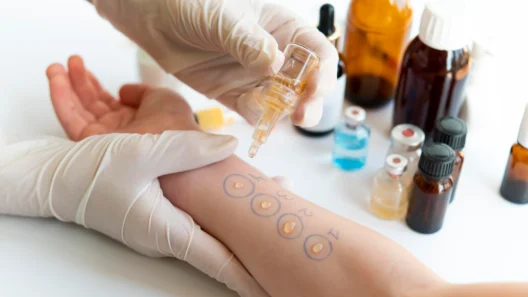
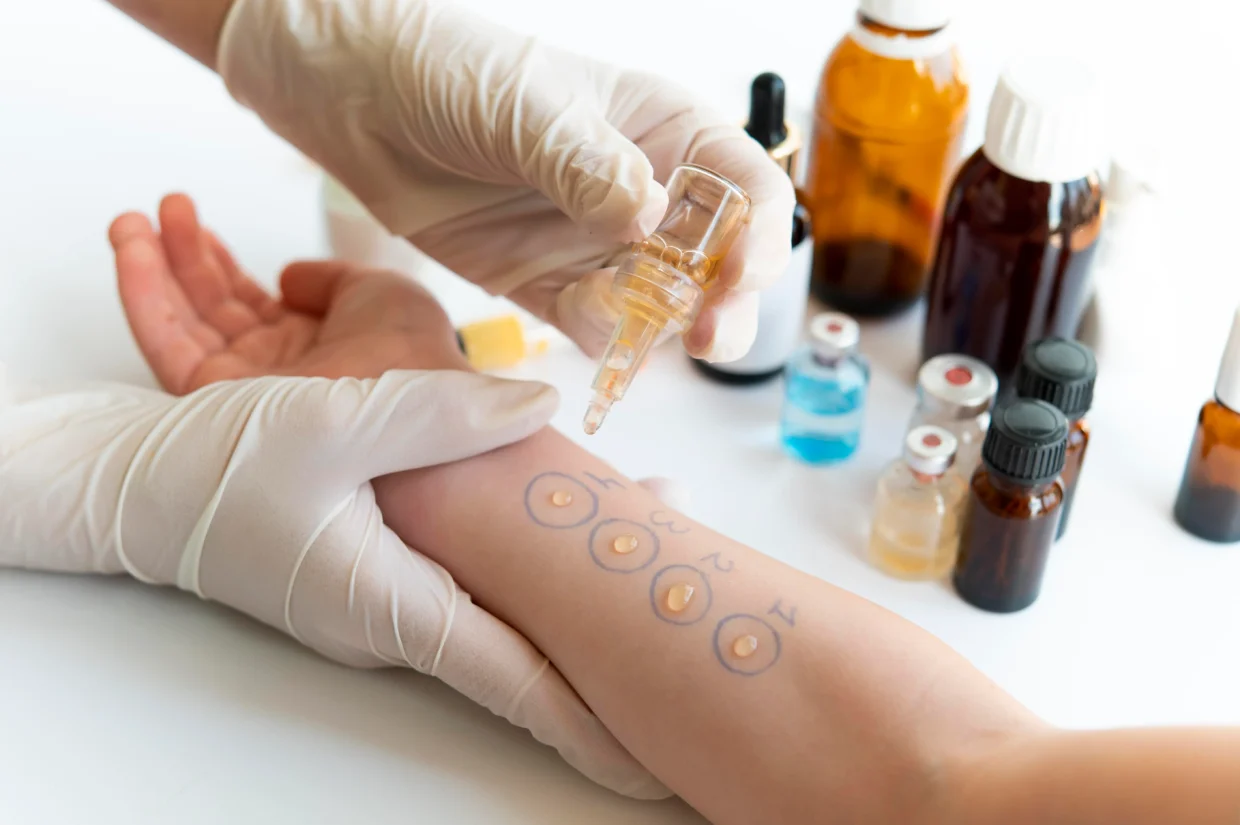
A cosmetic patch test checks how human skin reacts to a finished cosmetic product before it reaches consumers. A small amount of the product is applied to a specific area of skin, usually the inner forearm or back, and observed for a set period to identify possible unwanted reactions.
What Can a Patch Test Identify?
A cosmetic patch test is a controlled clinical assessment that evaluates how human skin responds to a finished cosmetic product.
During testing, a small quantity of the product is applied to a defined area of skin—usually the upper back or inner forearm and remains in contact with the skin for a specified period under controlled conditions.
- Skin irritation: A direct reaction that may appear soon after application.
- Allergic reactions: An immune response that can develop after exposure and may include contact dermatitis.
- Sensitisation: A gradual increase in skin reactivity that may not appear during initial use.
Patch Testing vs Laboratory Safety Testing
Patch testing and laboratory testing assess different parts of cosmetic safety. They work together but cannot replace each other.
| Patch Testing | Laboratory Safety Testing |
| Measures how human skin reacts to the finished product. | Checks microbiological quality, preservative effectiveness, stability, and packaging compatibility. |
| Helps identify irritation, allergic reactions, and sensitisation risks. | Confirms the product remains safe and stable throughout its shelf life. |
| Provides supporting evidence about skin tolerance. | Provides technical safety data used in the Cosmetic Product Safety Report (CPSR). |
Passing one type of test does not replace the other. A complete cosmetic safety assessment considers all available evidence to confirm that a product is safe for consumers.
Where Does Patch Testing Fit in the Cosmetic Compliance Process?
Understanding where patch testing fits into the wider compliance process makes the legal requirements easier to understand.
Complete Cosmetic Compliance Process
Before a cosmetic product can legally be sold in the UK or EU, brands usually complete the following steps:
- Product formulation and ingredient selection
- Laboratory testing, including microbiological and stability checks
- Patch testing, where appropriate for the product type
- Completion of the CPSR by a qualified safety assessor
- Preparation of the Product Information File (PIF)
- Appointment of a Responsible Person
- Product notification through the correct portal
- Legal sale on the market
Patch testing is one part of this process. It provides additional safety evidence when needed but does not replace the full cosmetic safety assessment.
Why Patch Testing Alone Is Not Enough
A patch test involves a limited number of participants, so it cannot predict every possible reaction across all consumers.
It cannot determine:
- Whether microbial contamination is present
- Whether preservatives remain effective over time
- Whether packaging affects product safety
- Whether ingredients exceed toxicological exposure limits
- Whether shelf life is supported by stability testing
The Cosmetic Product Safety Report considers many scientific factors beyond skin tolerance, including:
- Ingredient toxicology
- Margin of Safety (MoS)
- Exposure assessment
- Intended use
- Frequency of application
- Target users
- Packaging interaction
- Stability data
- Microbiological quality
For this reason, patch testing should always be viewed as supporting evidence rather than a standalone safety assessment.
Are Patch Tests Legally Required Under UK and EU Cosmetic Regulations?
Neither UK nor EU cosmetic law requires every cosmetic product to undergo a consumer patch test before it can be sold.
| Topic | UK Regulations | EU Regulation 1223/2009 |
| Main legal requirement | Cosmetic products must be safe for human health under normal and reasonably foreseeable use. | Cosmetic products must be safe for human health before being placed on the market. |
| Is patch testing mandatory? | No. Routine consumer patch testing is not required for every product. | No. Patch testing is not mandatory for every cosmetic category. |
| What is required instead? | A CPSR supported by appropriate safety evidence. | A documented cosmetic safety assessment completed by a qualified safety assessor. |
| When may patch testing be used? | When the safety assessor believes additional evidence is needed based on the product, ingredients, or claims. | When it supports the product’s safety assessment and risk profile. |
Why Patch Testing Is Not Automatically Mandatory
Cosmetic regulations focus on proving product safety rather than requiring one specific testing method for every product.
Patch testing is one possible source of safety evidence. The need for it depends on factors such as the formulation, ingredients, intended use, and cosmetic claims.
So, is allergy patch testing required for cosmetics under UK law? Not as a blanket rule. The decision is based on a risk assessment rather than a fixed legal checklist.
Who Decides Whether Patch Testing Is Needed?
The decision is not made by the brand owner alone. Several parties may contribute to the decision:
- Safety assessor: Reviews the formula and decides whether patch test data is needed to support the CPSR conclusion.
- Toxicologist: May provide additional input for higher-risk ingredients or complex formulations.
- Brand owner: Provides information about ingredients, intended use, and product claims.
- Testing laboratory: Performs the patch test according to the agreed testing protocol.
In most cases, the safety assessor’s professional judgement carries the most weight because they are responsible for the final safety assessment.
What Safety Testing Is Actually Required Before Selling Cosmetics?
Patch testing often receives the most attention, but it is only one part of cosmetic compliance. Brands need a combination of testing and documentation to demonstrate product safety.
| Safety Requirement | What It Checks |
| Cosmetic Product Safety Report (CPSR) | Reviews the formula, ingredient safety data, toxicological information, and product exposure before market approval. |
| Microbiological testing | Checks that the product does not contain unsafe levels of bacteria, yeast, or mould. |
| Preservative efficacy (challenge) testing | Confirms that the preservative system protects the product against microbial growth during use. |
| Stability testing | Checks how the formula performs over time and under conditions such as heat, cold, and light. |
| Packaging compatibility testing | The packaging does not negatively affect product safety or performance. |
The safety assessor reviews this evidence as part of the overall cosmetic safety assessment. Depending on the product’s risk profile, additional patch testing may be recommended.
How Patch Testing Affects Your Cosmetic CPSR Documentation
Many brands assume patch testing automatically becomes part of every CPSR. In reality, the need for testing depends on the formulation, ingredients, intended use, and product claims.
When Is Patch Testing Recommended?
A safety assessor may recommend patch testing when:
- The product contains ingredients with higher irritation potential.
- The product targets sensitive skin.
- Marketing claims require clinical support.
- Additional evidence is needed to confirm skin tolerance.
Products With Higher Irritation Potential
Ingredients associated with increased irritation may justify additional testing, including:
- Alpha Hydroxy Acids (AHAs)
- Beta Hydroxy Acids (BHAs)
- Retinoids
- High concentrations of Vitamin C
- Strong exfoliating ingredients
- Certain preservatives
- Essential oils
- Fragrance-rich formulations
Hair Dye Products
Hair colouring products deserve special attention because some ingredients—particularly p-Phenylenediamine (PPD) and related substances—are recognised sensitisers.
Manufacturers frequently conduct additional testing alongside mandatory consumer warnings.
Eye Area Cosmetics
Products intended for use around the eyes require particularly careful safety assessments due to the sensitivity of ocular tissues.
Additional clinical evidence may be appropriate depending on the formulation.
Products Making Specific Marketing Claims
Patch testing is commonly performed when brands intend to use claims such as:
- Dermatologically Tested
- Skin Tested
- Clinically Tested
- Suitable for Sensitive Skin
- Tested Under Dermatological Control
These claims should always be supported by genuine clinical evidence.
How Does Patch Testing Support a CPSR?
When completed, patch test results can be included as supporting evidence within the CPSR.
They are reviewed alongside:
- Ingredient safety data
- Exposure assessment
- Toxicological information
- Other product safety testing
Patch testing strengthens the safety assessment but does not replace the CPSR itself.
Can You Get a CPSR Without Patch Testing?
Patch testing is not a fixed requirement for completing a CPSR. For simple formulations made with well-established ingredients at safe concentrations, a safety assessor may decide that existing safety data is sufficient.
Additional testing may still be recommended when there are uncertainties, higher-risk ingredients, or specific cosmetic claims.
What Records Should Be Kept With Your CPSR and PIF?
Brands should keep:
- Final formula reviewed by the safety assessor
- Patch testing protocols and results, if performed
- Clinical reports supporting cosmetic claims
- Completed and signed CPSR
- Communication with the safety assessor about testing decisions
These records should be stored within the Product Information File (PIF).
When Is Patch Testing Recommended or Expected?
Some products and claims require stronger safety evidence because they have a higher chance of causing irritation or allergic reactions.
| Situation | Why Patch Testing May Be Recommended |
| Hair dye products | • Higher risk of allergic reactions from ingredients like PPD.• Many products include a 48-hour patch test warning before use.• Requires additional safety attention. |
| Sensitive skin products | • Supports sensitive skin claims.• Helps demonstrate skin tolerance.• Reduces risk of consumer complaints. |
| “Dermatologically tested” claims | • Requires genuine clinical testing evidence.• Supports marketing claims with proof.• Cannot rely only on ingredient reviews. |
| Higher-risk formulations | • Ingredients such as AHAs, BHAs, retinoids, essential oils, and strong fragrances may increase irritation risk.• May require additional safety evidence. |
The final decision depends on the product’s ingredients, intended use, and cosmetic claims.
How Is a Cosmetic Patch Test Performed?
Although testing methods can vary between laboratories, most professional cosmetic patch tests follow a similar step-by-step process. The aim is to check how human skin responds to the finished product and identify possible irritation or allergic reactions before wider use.
Step 1: Selecting Volunteers
A suitable group of volunteers is selected based on the testing protocol.
- Participants may represent different skin types.
- The number of volunteers depends on the type of test being performed.
- Testing is carried out with proper consent and safety procedures.
Step 2: Applying the Cosmetic Product
The finished cosmetic product is applied to a small, defined area of skin.
- The product is usually placed on the back or forearm.
- An occlusive patch may be used to keep the product in contact with the skin.
- The application method depends on the product type and intended use.
Step 3: Monitoring the Observation Period
The test area is monitored for signs of skin reactions.
- Most tests involve 24 to 48 hours of observation.
- Some protocols include later checks to identify delayed reactions.
- Assessors look for redness, itching, swelling, or irritation.
Step 4: Dermatologist Evaluation
A dermatologist or trained assessor reviews the skin response.
- Reactions are graded using standard evaluation scales.
- Results may range from no visible reaction to noticeable irritation.
- The findings help determine the product’s skin tolerance.
Step 5: Understanding the Results
The results show how participants responded to the product.
- Results may record the percentage of users with no reaction, mild reaction, or stronger irritation.
- The final interpretation depends on the product type and testing method.
| Factor | Why It Matters |
| Occlusive vs open patch | Occlusive patches increase product contact with the skin and may highlight potential reactions. |
| Leave-on vs rinse-off products | Leave-on products usually require more cautious assessment because they stay on the skin longer. |
| Diluted vs undiluted application | Some tests use diluted samples to reduce false positives and improve accuracy. |
How Long Does Patch Testing Take?
A standard cosmetic patch test usually involves around 48 hours of direct observation, but some protocols include follow-up checks at 72 or 96 hours to detect delayed reactions.
After testing is completed, reviewing the results and adding the findings to your safety documentation may take another one to two weeks, depending on the laboratory and safety assessor’s process.
Common Patch Testing Mistakes Cosmetic Brands Should Avoid
| Common Mistake | Why It’s a Problem | What to Do Instead |
| Assuming every cosmetic needs patch testing | Many low-risk products do not need patch testing. Spending money unnecessarily can take the budget away from essential compliance. | Check with your safety assessor before arranging patch testing. |
| Confusing customer patch tests with clinical testing | Home patch tests help consumers but cannot support cosmetic claims like “hypoallergenic” or “dermatologically tested.” | Use professional clinical testing for marketing claims. |
| Making unsupported marketing claims | Claims such as “dermatologically tested” require real testing evidence. Unsupported claims can lead to regulatory action. | Only make claims backed by reliable evidence. |
| Skipping laboratory testing | A product may pass a patch test but still fail microbiological, challenge, or stability testing. | Complete all required laboratory testing before launch. |
| Launching before the CPSR is complete | Selling a product without a signed CPSR is not legally compliant, even for a small launch. | Finalise your CPSR and PIF before selling your product. |
Patch Testing Checklist for Small Cosmetic Brand Owners
Following this patch testing guide for small cosmetic brand owners UK step by step reduces the risk of gaps in your documentation later on.
Finalise your product formulation
Complete laboratory testing, including microbiological and stability checks
Review ingredient risks with your safety assessor
Confirm whether your product needs patch testing before your CPSR is finalised
Obtain your CPSR from a qualified safety assessor
Prepare your PIF with all supporting documentation, including patch test CPSR evidence where relevant
Support any cosmetic claims with proper clinical testing
Notify your product through the correct regulatory portal
Keep all compliance records updated and accessible
Conclusion
Patch testing is not something UK or EU law automatically demands for every cosmetic product. What both frameworks actually require is proof of safety, and that proof comes from your CPSR and PIF, built on proper laboratory testing, ingredient safety review, and a qualified cosmetic safety assessment.
Patch testing earns its place as part of that evidence when the product calls for it. Hair dyes, sensitive skin formulas, higher-risk ingredients like AHAs and retinoids, and any “dermatologically tested” claim all raise the bar, and a solid patch test CPSR record becomes far more important in these cases.
The brands that avoid problems later are the ones that treat compliance as a full process, not a single test. Get your formulation, documentation, and safety assessment right from the start, and patch testing will simply fall into place where it’s genuinely needed.
Frequently Asked Questions
Is a patch test a legal requirement in the UK?
UK cosmetic law does not require every cosmetic product to undergo a consumer patch test before sale. Brands must prove product safety through a CPSR and supporting documentation, while patch testing may be used when additional evidence is needed.
What are the EU regulations for cosmetics?
EU cosmetics are regulated under Regulation (EC) No 1223/2009. The regulation requires products to be safe for human health, supported by a cosmetic safety assessment, correct labelling, a Responsible Person, and a Product Information File (PIF).
How do you patch test cosmetic products?
A small amount of the finished product is applied to a defined area of skin, usually under a controlled patch. The test area is then monitored for reactions such as redness, itching, irritation, or allergic responses over a set observation period.
Is patch testing required before getting a CPSR?
Patch testing is not a mandatory requirement for every CPSR. A qualified safety assessor decides whether patch test data is needed based on the formulation, ingredients, intended use, and product claims.
Can you claim “dermatologically tested” without clinical testing?
A “dermatologically tested” claim should be supported by genuine clinical testing evidence. Brands should not use this claim based only on ingredient safety information or internal product checks.
Which cosmetic products are most likely to need patch testing?
Products with higher irritation or allergy risks are more likely to need patch testing, including hair dyes, sensitive skin products, formulas with strong fragrances, and products containing ingredients such as AHAs, BHAs, or retinoids.
Does home patch testing replace professional cosmetic safety testing?
Consumer patch testing at home can be a useful precaution, but it cannot replace professional testing, clinical evidence, or the cosmetic safety assessment required for compliance.